Canada continues to face high rates of youth vaping and nicotine use. A Smoke-Free Generation is a gradual, long-term approach that would ensure future generations cannot legally purchase commercial nicotine products, helping stop nicotine addiction before it starts.
Together, we can help create a future where the next generation never becomes addicted to nicotine.
of Canadians say it’s important to prevent children from ever taking up smoking or vaping.
support stronger rules to keep tobacco and vaping products out of the hands of youth.
support a Smoke-FreeGeneration law.
CANADIANS ARE READY TO HELP BUILD A
SMOKE-FREE
GENERATION.
Most nicotine addiction starts young.
Nicotine is a highly addictive drug. The younger someone starts using nicotine, the greater the risk of lifelong addiction.
Canada's youth are facing a growing nicotine crisis.
Canada has among the highest youth vaping rates in the world.
12% of high school students are vaping daily
Nicotine is a highly addictive drug that poses unique dangers to youth.
Nicotine can:
Harm brain development
Affect attention, learning, memory, and mood
Increase the risk of future addiction to other drugs
Negatively affect mental health and well-being
WHAT IS A SMOKE-FREE GENERATION
A simple idea designed to prevent future generations from becoming addicted to tobacco by gradually raising the legal age at which tobacco products can be sold.
HOW IT WORKS:
Current Adults
No change. Adults who can legally purchase nicotine products today would continue to do so.
Born in 2009 or Later
Would never become eligible to purchase commercial nicotine products.
A Smoke-FreeGeneration
Over time, fewer young people become addicted to nicotine, creating a healthier future for all Canadians.
Building a Smoke-FreeGeneration starts with understanding how the policy works. Explore the infographic below for a quick overview of the key facts and common misconceptions:
Smoke-Free Generation: What It Is and What It Isn’t
A Smoke-Free Generation is a practical, evidence-informed approach to protecting future generations from nicotine addiction, before it starts.
A plan to prevent youth nicotine addiction before it starts.
Future generations would never become eligible to purchase commercial nicotine products.
A gradual approach focused on future generations.
The policy phases in over time and does not affect current adults or anyone who is of legal age to purchase nicotine and tobacco products.
Protection from cigarettes, vape and other nicotine products.
The approach applies to more than just cigarettes.
A long-term strategy to improve public health.
Designed to reduce nicotine addiction and tobacco-related disease over time.
V
S
Smoke-Free Generation does not ban nicotine products for adults who can legally purchase them today.
Adults who can legally purchase nicotine products today would continue to do so.
Smoke-Free Generation does not affect Indigenous sacred or ceremonial tobacco use.
Traditional tobacco used in First Nations ceremonial, spiritual, learning, and healing practices would not be affected.
Smoke-Free Generation does not require current users to quit
The policy does not force existing users to stop using nicotine products.
A Smoke-Free Generation policy is not a restriction on products already legally purchased by adults.
It does not affect adults or anyone of legal age who already purchase or use tobacco or nicotine products.
It is not a sudden prohibition affecting existing consumers.
Changes would occur gradually over decades, not overnight.
What products are included?
The policy would apply to commercial nicotine products, including:
Cigarettes
Cigars
Vapes and e-cigarettes
Smokeless nicotine products
Future nicotine products not yet on the market
Many of these products are marketed and designed specifically to appeal to youth. In addition, young people are being exposed to media messages that present nicotine products as appealing or aspirational.
Smoke-Free Generation is about more than cigarettes.
Like conventional cigarettes, vaping products can expose users to:
Cancer-causing chemicals
Heavy metals such as nickel, tin, and lead
Particles that can be inhaled deep into the lungs
Chemicals linked to serious lung disease
The goal is simple: build a Smoke-Free Generation by preventing future generations from becoming addicted to nicotine, regardless of how nicotine products may change or evolve over time.
THE PLEDGE
Protect youth today. Build a healthier future tomorrow.
The National Lung Health Alliance is calling on Canada’s federal government to:
Reduce youth appeal.
Restrict flavoured tobacco, vaping, and nicotine products that can make nicotine use more appealing to youth.
Create a Smoke-Free Generation.
Gradually phase out commercial nicotine sales for future generations born on or after January 1, 2009.
Strengthen enforcement.
Improve inspections, border controls, and market oversight to reduce youth access to nicotine products.
Follow international best practices.
Implement the policy gradually and responsibly, informed by lessons from other countries.
TAKE THE PLEDGE
Help build a Smoke-FreeGeneration.
Every pledge shows decision-makers that Canadians support protecting children and youth from nicotine addiction before it starts.
Add your name and help build a Smoke-Free Generation.
Help Spread the Word.
Share the campaign with friends, family and colleagues.
WHY NOW?
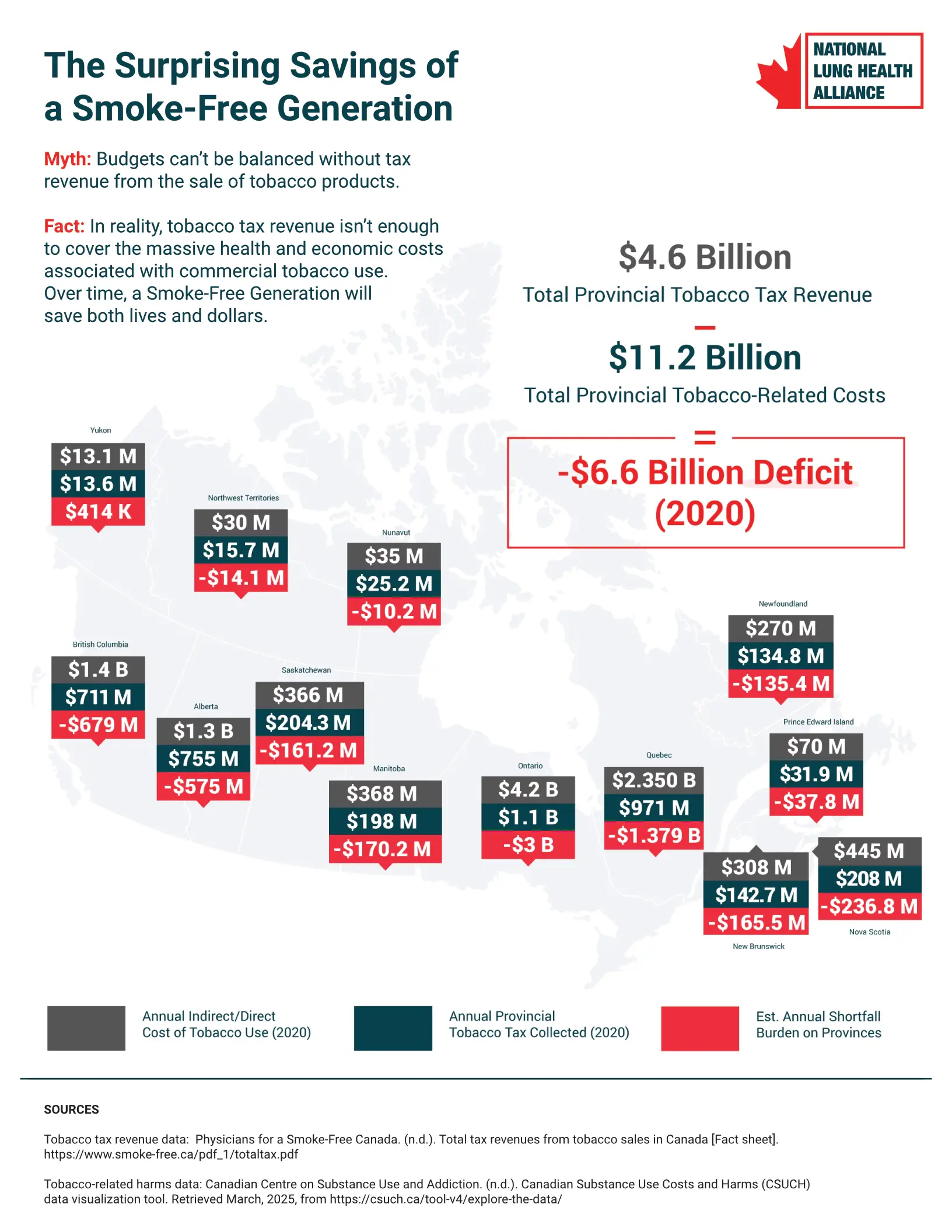
The cost impacts all of us.
Tobacco use costs Canada an estimated $16.5 billion annually in health-care costs, lost productivity and premature death. Those costs exceed government tobacco tax revenues.
SOURCES
Tobacco tax revenue data: Physicians for a Smoke-Free Canada. (n.d.). Total tax revenues from tobacco sales in Canada [Fact sheet]. https://www.smoke-free.ca/pdf_1/totaltax.pdf
Tobacco-related harms data: Canadian Centre on Substance Use and Addiction. (n.d.). Canadian Substance Use Costs and Harms (CSUCH) data visualization tool. Retrieved March, 2025, from https://csuch.ca/tool-v4/explore-the-data/
CANADA WOULDN'T BE ALONE
Canada would join a growing number of countries around the world who are already taking steps to build their own Smoke-Free Generations.
Some governments have introduced Smoke-Free Generation policies, while others have focused on restricting flavours that appeal to youth and children, or strengthening controls on vaping products.
At a Glance: How Countries Are Taking Action
Approach
Country
Current Status
Smoke-Free Generation Policy
Maldives
In force since 2025
Smoke-Free Generation Policy
United Kingdom
Takes effect January 1, 2027
Flavoured Cigarette Restrictions
European Union
Menthol cigarette ban in force since 2020
Vape Flavour Bans In Force
Finland
Only tobacco-flavoured e-liquids are permitted for sale. Fruit, candy, dessert, mint and menthol flavours are prohibited (Since 2016)
Vape Flavour Bans In Force
Netherlands
Only tobacco-flavoured e-liquids are permitted for sale (Since 2024)
Vape Flavour Bans In Force
Latvia
Only tobacco-flavoured e-liquids are permitted for sale (Since 2024)
Vape Flavour Restrictions
Belgium
Under consideration
Vape Flavour Restrictions
France
Under consideration
Vape Flavour Restrictions
Greece
Under consideration
Vape Flavour Restrictions
Portugal
Under consideration
Vape Flavour Restrictions
Spain
Under consideration
Outright Ban on Vapes
Mexico
In force
8 in 10
(80%) Canadians aged 18-29 back a Smoke-Free Generation law
85%
Canadians support restricting youth-appealing vape flavours, including candy, fruit and other sweet flavours
The answer is yes.
Canadians overwhelmingly support actions that help build a Smoke-Free Generation.
Whether you’re a parent, educator, health professional, community leader, or simply curious to learn more, these resources can help you navigate conversations with children and young people and stay informed about the latest research, policies, and prevention strategies.
Browse our collection of guides, toolkits, research, podcasts, and educational resources:
Lung Saskatchewan’s “Understanding Youth Vaping” a Let’s Talk Lungs Podcast
Learn more about youth vaping and vaping-related health risks in this episode of Let’s Talk Lungs, featuring expert insights from respirologist Dr. Erika Penz for parents, educators and caregivers.
Talking with your teen or child about vaping can feel challenging. This BC Lung resource offers tips on how to answer common questions about vaping with clear, age-appropriate, evidence-based responses. Available in 6 languages.